Quick Summary
- Automatic feeders suit shift workers, multi-pet homes, weight management plans and cats who wake you at 5am for breakfast.
- Three main types: gravity feeders, programmable timed feeders and app-connected smart feeders, each with different strengths.
- Check hopper capacity, kibble compatibility, portion accuracy and battery backup before you buy.
- Stainless steel bowls are easier to keep hygienic than plastic, and matter for cats prone to chin acne.
- A feeder is a feeding tool, not a substitute for checking on your pet. It should never be used to extend the time a pet is left alone beyond what is safe.
If you have ever sprinted down the stairs at 5am because a cat is standing on your chest demanding breakfast, or worried about a dog’s dinner being late because a shift ran over, an automatic pet feeder solves a genuinely common problem. This guide walks through who benefits most, the different types on the market, and the practical features worth checking before you buy one, so you end up with a feeder that suits your pet rather than one that just looked good in a photo.
Who actually benefits from an automatic feeder
Automatic feeders are not just a gadget for the sake of it. A few situations come up again and again where owners find one genuinely useful.
- Shift workers and irregular schedules. If your working hours do not match your pet’s usual mealtimes, a timed feeder keeps meals consistent even when you are not home to serve them.
- Weight management. Portioned, scheduled meals make it far easier to stick to a controlled feeding plan than guessing by eye, particularly useful if your vet has recommended weight loss or maintenance feeding. Our guide to how much to feed a cat covers how to work out a sensible portion in the first place.
- Cats who demand an early breakfast. Many cats are naturally more active around dawn and dusk. A feeder set to dispense before you wake up can spare you the 5am wake-up call. Keeping an indoor cat occupied during the day can also help, see our guide to indoor cat enrichment.
- Multi-pet households. Feeders can help stagger mealtimes or separate portions so a faster eater does not simply finish their own bowl and move on to someone else’s.
- Short absences. A feeder can cover a single missed meal if you are running late, though it is not a solution for extended time away from a pet, which we cover further down.
The three main types of automatic feeder
Gravity feeders
The simplest option. A hopper sits above an open tray and food drops down by gravity as the pet eats, keeping the tray topped up. There is no timer and no portion control, food is simply available whenever the hopper has stock.
Gravity feeders work reasonably well for dogs and cats who self-regulate their intake and graze steadily through the day. They are a poor choice for any pet prone to overeating, since there is nothing to stop them clearing the tray in one sitting.
Programmable timed feeders
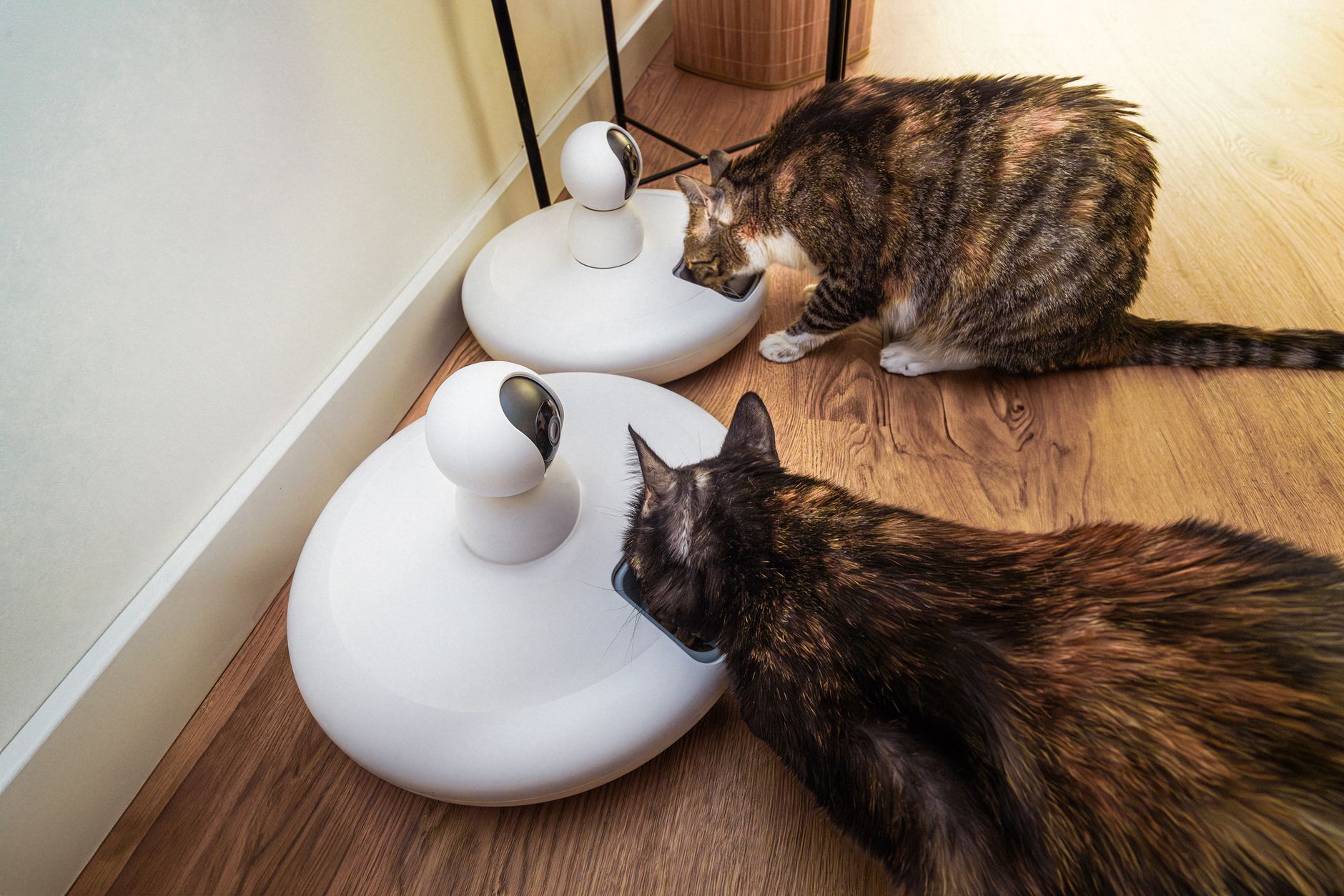
These dispense a set portion at set times, controlled by a dial or small screen on the unit itself. This is the middle ground most owners land on: enough structure to manage portions and schedule, without needing an app or a strong wifi signal.
A timed feeder with a stainless steel bowl, like the one we stock, is a straightforward way to get consistent, scheduled meals without extra complexity. You can browse the current feeder in our shop.
App-connected smart feeders
These add wifi connectivity, letting you trigger an extra meal remotely, adjust schedules from your phone, and sometimes track how quickly your pet eats or view them via a built-in camera. They are the most flexible option but also the most dependent on a stable home wifi connection and a working app, which is worth bearing in mind if your household wifi is unreliable.
Portion accuracy matters more than you’d think
Not all feeders measure a portion the same way. Some use a rotating disc with fixed-size compartments, others use an auger screw that dispenses by rotation count, and cheaper units can be inconsistent between meals. If you are feeding for weight management, ask or check reviews for how consistent the portion sizes actually are in practice, since a feeder that varies by a third from one meal to the next undermines the whole point of using one.
Hopper capacity and food compatibility
Check the hopper capacity against your pet’s daily intake and how often you are willing to refill it. A larger hopper means fewer refills but takes up more counter or floor space.
Kibble size matters too. Most automatic feeders are built for dry kibble within a certain size range, and very large or oddly shaped kibble can jam the dispensing mechanism. If you feed an unusual kibble shape, check the feeder’s stated compatibility before buying.
Most automatic feeders do not handle wet food well. The mechanisms are built for pouring or rotating dry kibble, and wet food will stick, clog, and spoil if left sitting in a hopper or bowl for hours, which is also a food safety issue in warm weather. If your pet eats wet food, an automatic feeder is best used for dry meals or treats only, alongside your normal wet feeding routine.
Power, battery backup and why mains-only is a risk
A feeder that only runs on mains power will simply stop working during a power cut, which could mean a missed meal at exactly the moment you are not there to notice. Look for a feeder with battery backup, so scheduled meals still dispense even if the power drops out. This is one of the more overlooked features and one of the most important, particularly if you rely on the feeder while you are out of the house.
Jam resistance and build quality
Dispensing mechanisms can jam, especially with irregular kibble shapes or if the hopper has damp food stuck inside it. A well-built feeder is easier to clear if it does jam, and keeping the hopper dry and the kibble fresh reduces the chances of it happening in the first place.
Cleaning and why stainless steel beats plastic
Food bowls need regular washing, and the bowl material makes a real difference to how easy that is.
| Bowl material | Hygiene | Practical notes |
|---|---|---|
| Stainless steel | Non-porous, does not retain bacteria or odours, dishwasher-safe | Resists scratching, which matters because scratches in plastic trap bacteria over time |
| Plastic | Porous once scratched, can harbour bacteria in fine grooves | Cheaper initially but needs replacing more often as it wears |
For cats specifically, plastic bowls are commonly associated with feline chin acne, a build-up of blackheads and irritation along the chin. International Cat Care notes that contact with plastic feeding bowls is thought to be one of several possible contributing factors, alongside grooming habits and skin type. Stainless steel is far less likely to harbour bacteria in scratches the way worn plastic can. If you are choosing a feeder partly to help a cat with chin acne, a steel bowl unit is a sensible choice, though do speak to your vet if the acne is severe or not improving, since it can occasionally need veterinary treatment.
Noise and nervous pets
Motorised dispensing mechanisms make some noise when they release food, usually a whirring or clicking sound. Most pets learn to associate the sound with mealtime and are not bothered by it, but a nervous or noise-sensitive pet may need a gradual introduction (see below) rather than being left alone with an unfamiliar feeder from day one.
Security against determined pets
Some dogs and cats are remarkably good at working out how to tip a feeder over or lever a hopper lid open, especially if they know there is food inside. If you have a persistent or food-motivated pet, look for a feeder with a secure, latching lid and a stable, weighted base, and consider where you place it, away from surfaces it could be knocked from.
Transitioning your pet to a feeder gradually
Do not switch a pet straight to unsupervised automatic feeding on day one. A gradual introduction avoids stress and gives you time to check the feeder is working as expected.
- Place the feeder where the food bowl usually sits and let your pet investigate it while you are home, with no food inside at first.
- Run a manual dispense while you are present, so they hear the noise and see food appear, building a positive association.
- Use it for one meal a day while you are still home to supervise, checking the portion actually dispenses correctly.
- Gradually move to your intended schedule, including times you are out of the house, once you are confident it is working reliably.
The honest limits of an automatic feeder
An automatic feeder solves a feeding logistics problem. It does not replace checking on your pet, providing fresh water, or the general care and company they need. Do not use a feeder as a way to extend how long a pet is left alone beyond what is safe and appropriate for that animal, and always make sure fresh water is available separately, since feeders only manage food. If you are ever unsure whether a feeding or care routine is suitable for your specific pet, a vet or a recognised welfare body such as the RSPCA is the right place to check.
For dogs specifically, the Kennel Club is a useful source of general care guidance alongside your vet. If you are also working on other parts of your dog’s routine, our guide to essential dog accessories covers the wider kit most owners end up needing.
Frequently Asked Questions
Can I use an automatic feeder for wet food?
Most automatic feeders are designed for dry kibble only. Wet food left sitting in a hopper or bowl for hours can spoil and clog the mechanism, so it is best kept to your normal wet feeding routine rather than an automatic dispenser.
How long can I leave my pet with just an automatic feeder?
An automatic feeder covers meals, not overall care. It should never be used to extend the time a pet is left alone beyond what is safe, and pets still need fresh water, company and welfare checks that a feeder cannot provide.
Will an automatic feeder work during a power cut?
Only if it has battery backup. A mains-only feeder will stop dispensing during a power cut, so battery backup is worth checking for before you buy, especially if you rely on the feeder while out of the house.
Are stainless steel bowls really better than plastic?
Yes, for hygiene. Stainless steel is non-porous and resists scratching, so it does not trap bacteria the way a scratched plastic bowl can, and it is linked to fewer cases of feline chin acne in cats.
My cat keeps breaking into the feeder early. What can I do?
Look for a feeder with a secure latching lid and a stable base, and place it somewhere it cannot easily be tipped over. Some cats are persistent, so a well-built, secure unit makes a real difference.
Should I introduce a feeder gradually?
Yes. Let your pet investigate it while you are home, run a few supervised manual dispenses, and use it for one meal a day before moving to your full intended schedule.